The Traumatic Stress Institute gathers twice a year for staff retreat. The retreats last a few days and give us the space to step back from daily demands and reconnect as a team. These retreats are a time to reflect on what we’ve accomplished, clarify our direction, and explore new ideas that will shape our work moving forward.
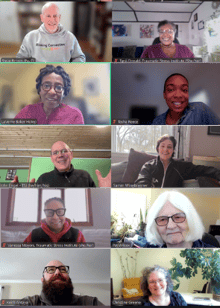
Our most recent retreat was online in January (see picture) and included a phenomenal learning session co-led by Tanji L. Donald, M.Ed., Program Coordinator, and Samm Winebrenner, Operations Coordinator.
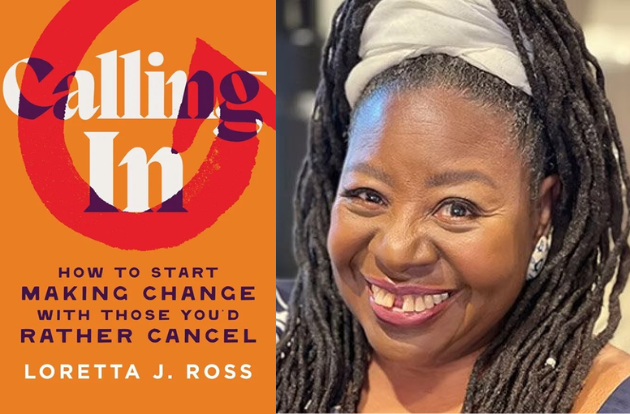
In preparation, everyone on the team was asked to view a TED Talk by longtime human rights activist, author, and professor Loretta J. Ross. We then came together for a thought-provoking discussion. We'd love to share this talk with you and encourage you to consider using it for a discussion group in your own community or workgroup.
TED Talk and Book
In her 2021 TED Talk and her 2025 book Calling In: How to Start Making Change with Those You'd Rather Cancel, Loretta J. Ross recalls a formative moment in her career when her mentor, Reverend C.T. Vivien – who had been an aide to Dr. Martin Luther King, Jr. – said, "When you ask people to give up hate, you need to be there for them when they do." Her mentor sowed the seed which she has nurtured into a movement that leads with love instead of anger, and it feels like an imperative conversation to have at this moment in our country.
Ms. Ross believes that "calling in will be to the current movement what nonviolence was to the civil rights movement in the 20th century," and that, "most of us want all this violence to stop but we don't know where to begin." Calling In is an invitation to have more productive conversations across our differences. It also aligns with the four components of healing relationships – R.I.C.H. (Respect, Information, Connection, and Hope) – in the Traumatic Stress Institute's Risking Connection training.
Definitions
In her work, Ms. Ross offers these foundational concepts as a gateway to understanding the dynamics of conflictual relationships and conversations:
- Calling In. Leading with love while holding people accountable for harmful behavior through respectful, private dialogue rather than public condemnation.
- Calling Out. Also known as "cancel culture", the public shaming or denunciation of individuals for perceived transgressions, aimed at holding them accountable through humiliation.
- Calling On. A middle ground between calling in (loving conversation) and calling out (public shaming). This strategy invites self-reflection while reducing defensiveness to address the gap between a harmful behavior and a person's values.
- Calling Off. While not discussed in the video, "calling off" is presented in the book as an option when things go off the rails; it's a choice to disengage (temporarily or permanently) when a conversation becomes toxic or unproductive.
Suggested Group Discussion in 4 Steps
Step 1. Set the Scene. Preparation for your discussion.- Watch the TED Talk. Loretta J. Ross' talk is about 14 minutes long. Decide whether you'll watch it together or ask your participants to watch it independently prior to the discussion. This activity is approximately 1 hour long if the video is viewed within the meeting.
- Set the Scene for Safety. Provide a calm space free of interruptions and make time for introductions if participants don't know each other well. Provide a process to establish group agreements in order to create a safe space for sharing.
Step 2. All the Callings. 10 minutes, whole-group discussion.
- Prompt: Ask participants to share examples of calling out, calling in, and calling on. Encourage brief responses for this section.
- Facilitate the discussion regarding the pros and cons of each approach. Ask participants to reflect on the effects of each approach on outcomes.
Step 3. Calling Out. 2 minutes instruction, 8 minutes in breakout groups, 10 minutes whole group discussion (for a total of 20 minutes in this section).
- Remind participants of the group agreements as you go into breakout groups of 2, while framing that each will share a brief story that will not be shared with the larger group. Encourage reflective listening and validation on the part of the listener.
- Instruct participants to take turns and reflect on a "calling out" experience when they may have hurt someone or someone hurt them. Ask them each to share their item in this format: "What happened"; "What I regret"; and "What I'm doing differently".
- When returning to the whole-group discussion, the goal is to humanize our mistakes, promote an understanding that we all struggle with living up to our ideals, and to encourage valuing repair over punishment. Trust plays a strong role in the process.
- Questions for the whole group could be: What emotions were involved? When telling your story, how easy or hard was it to reconnect with your sense of righteousness, indignation, or shame (depending on your role in the incident)? Regarding the person you were in conflict with, what is your relationship like now? What would it take to let go of that feeling, and would you like to let go of it?
Step 4. Calling In and Calling On. 15 minutes, whole group discussion.
- Questions for the whole group to discuss: How could call-in culture strengthen relationships, communities, or online spaces? What about call-on culture? When might one be better than the other?
- The goal is to discuss the benefits of these cultures and consider possible pathways forward that could improve both our connection to each other and outcomes of conflict resolution.
In Conclusion
Some may balk at the idea of leading with love toward those who have caused such profound harm. But Loretta J. Ross makes the point that you can't build a human rights movement by violating people's human rights or denying their humanity. Accountability and empathy are not opposites; it is possible to hold people responsible while still showing up with connection and care. What moves us forward is opening doors to repair.
Each of us lives with the tension between our ideals and our reality. We are imperfect, complicated, and – ultimately – part of the same human family.
