---
title: "Enduring Impact: What Our Community Is Saying About Risking Connection"
description: Discover the enduring impact of Risking Connection training and how it transforms trauma-informed care through testimonials from professionals. Explore the ripple effects on our LinkedIn page.
image: https://blog.traumaticstressinstitute.com/hubfs/Testimonials%20Blog%20Post.png
---
[](https://traumaticstressinstitute.org/)
- [About](https://www.traumaticstressinstitute.org/about-2/)
- [Vision - Mission - Values](https://www.traumaticstressinstitute.org/about-2/mission/)
- [Traumatic Stress Institute Staff](https://www.traumaticstressinstitute.org/about-2/staff/)
- [TSI Faculty Trainers](https://www.traumaticstressinstitute.org/about-2/rc-faculty-trainers/)
- [Sidran](https://www.traumaticstressinstitute.org/sidran-redirect/)
- [History of Traumatic Stress Institute](https://www.traumaticstressinstitute.org/about-2/company-history/)
- [Klingberg Family Centers](https://www.traumaticstressinstitute.org/about-2/klingberg-family-centers/)
- [Careers](https://www.traumaticstressinstitute.org/careers/)
- [Trauma-Informed Care](https://www.traumaticstressinstitute.org/what-is-trauma-informed-care/)
- [What Is Trauma Informed Care?](https://www.traumaticstressinstitute.org/what-is-trauma-informed-care/)
- [Trauma-Informed Care for Organizations](https://www.traumaticstressinstitute.org/trauma-informed-care-for-organizations/)
- Risking Connection
- [RC 25th Anniversary](https://www.traumaticstressinstitute.org/rc-25th-anniversary/)
- [Risking Connection Change Model to Trauma-Informed Care – Standard](https://www.traumaticstressinstitute.org/services/risking-connection-change-model/)
- [IDD Organizations & Systems](https://www.traumaticstressinstitute.org/services/risking-connection-change-model-idd/)
- [Current Client Agencies of the Traumatic Stress Institute](https://www.traumaticstressinstitute.org/services/whole-system-transformation-to-trauma-informed-care-tic/agencies-using-rc-as-training-model/)
- [Risking Connection® (RC) Training](https://www.traumaticstressinstitute.org/risking-connection-training/)
- [Restorative Approach® (RA) Training](https://www.traumaticstressinstitute.org/services/restorative-approach-training/)
- [ARTIC Scale](https://www.traumaticstressinstitute.org/the-artic-scale/)
- [Training Events](https://traumaticstressinstitute.org/events/)
- [Trainers' Corner](https://traumaticstressinstitute.org/trainers-corner/)
- [Blog](https://blog.traumaticstressinstitute.com/blog)
- [Books](https://www.traumaticstressinstitute.org/books/)
- [Helplines](https://www.traumaticstressinstitute.org/hotline-list/)
- [Contact](https://traumaticstressinstitute.org/contact/)
### Subscribe to updates
### Categories
- [Whole-System Change (52)](https://blog.traumaticstressinstitute.com/blog/tag/whole-system-change)
- [Measurement & Research (27)](https://blog.traumaticstressinstitute.com/blog/tag/measurement-research)
- [Mindfulness (24)](https://blog.traumaticstressinstitute.com/blog/tag/mindfulness)
- [IDD Organizations (11)](https://blog.traumaticstressinstitute.com/blog/tag/idd-organizations)
- [Crisis Response (8)](https://blog.traumaticstressinstitute.com/blog/tag/crisis-response)
- [Head Start (8)](https://blog.traumaticstressinstitute.com/blog/tag/head-start)
- [Insider (1)](https://blog.traumaticstressinstitute.com/blog/tag/insider)
See all
This is a search field with an auto-suggest feature attached.
- There are no suggestions because the search field is empty.
### Recent Posts
[](https://blog.traumaticstressinstitute.com/blog/enduring-impact-what-our-community-is-saying-about-risking-connection)
# [Enduring Impact: What Our Community Is Saying About Risking Connection](https://blog.traumaticstressinstitute.com/blog/enduring-impact-what-our-community-is-saying-about-risking-connection)
February 20, 2026 / by [Christine Greene](https://blog.traumaticstressinstitute.com/blog/author/christine-greene)
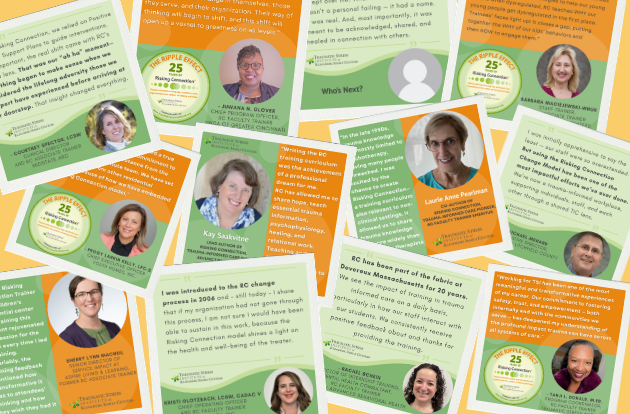
Over the past year as we've celebrated [Risking Connection's 25th anniversary](https://www.traumaticstressinstitute.org/rc-25th-anniversary/), we’ve also been sharing something special on our LinkedIn page: the voices of our community.
Through testimonials from trainers, clinicians, educators, and leaders, one theme has emerged again and again – the enduring impact of Risking Connection (RC).
## The Training That Stays With You...
One former trainer reflected that more than 20 years after her initial training, she still considers Risking Connection the most influential and impactful professional development experience of her career.
*Twenty years!*
In a field where new models, buzzwords, and frameworks regularly emerge, that kind of staying power says something profound. These aren’t just positive reviews; they are reflections from seasoned professionals who have integrated trauma-informed principles deeply into their work – and who continue to see the results.
## ...But Risking Connection is More than a Training
Across the testimonials we’ve shared, people describe Risking Connection not simply as a curriculum, but as:
- A shift in perspective
- A new, shared language for understanding behavior
- A framework for building healing relationships
- A guide for supervision and leadership
- A foundation that shapes organizational culture
Many speak about how the training helped them move from asking, “What’s wrong with this person?” to, “What happened to this person?” That shift alone can be transformative.
Others describe how the concepts continue to inform their work decades later, influencing how they supervise teams, structure programs, sustain themselves through the work, and support clients and their families.
## The Ripple Effect
One of the most heartening patterns in these testimonials is the ripple effect. A clinician trained years ago now trains others. A supervisor who once attended the RC Basic training as a participant now leads trauma-informed initiatives within their organization. Entire agencies have adopted the model to create more relational, responsive environments.
What began as a single training has grown into a supportive, 18-24 month [Risking Connection Change Model](https://www.traumaticstressinstitute.org/services/risking-connection-change-model/) that helps organizations transform their whole culture, which affects staff engagement and safety, while improving client outcomes.
## Why We're Sharing These Stories
At the Traumatic Stress Institute, we believe stories matter. Hearing directly from professionals who have carried this work forward for years – and even decades – reminds us why this model endures.
It works not because it is trendy, but because it is grounded in something timeless: the healing power of relationship.
To everyone who has shared their experience with us over the past year – thank you. Your reflections inspire new learners, validate longtime practitioners, and remind us that trauma-informed work is not a moment, but a commitment. It takes a willingness to break the status quo, yes, but it provides long-lasting benefits.
If you haven’t yet read the testimonials, we invite you to explore them on our LinkedIn page – and to consider what lasting impact trauma-informed training could have in your own work. Ready to take next steps? [Request a free consultation](https://share.hsforms.com/1AC83_-yRTE24kdomOqdSMg42x2v).
More stories are still to come. And the ripple effect keeps expanding outward.
[](https://blog.traumaticstressinstitute.com/hs/cta/wi/redirect?encryptedPayload=AVxigLIjFamIXLpJ9HuOleCyjBT2kqsGJzAdh5ZXqEid5K0GfFBmaVdCJk8AxR3Feeo6u9Bvx0k4UhqTLDGqpsUqaJZqKoU5%2BWC1iB41hRzb2adfXqauOnoo5uaE1zjMeh3G5Ysmfmk0U4UILWOzi2tlzTA1daWdISndxFalUvkQdAiJlQI7FUT0U%2FX7%2BIepYLWvEidn9SZlpmFf%2Fg3CkZfNCHfRspmWCIuo&webInteractiveContentId=208044788563&portalId=6854647)
Tags: [Whole-System Change](https://blog.traumaticstressinstitute.com/blog/topic/whole-system-change)

#### Written by [Christine Greene](https://blog.traumaticstressinstitute.com/blog/author/christine-greene)
Chris Greene is the Marketing Coordinator for the Traumatic Stress Institute of Klingberg Family Centers. Her work includes marketing and implementing systems improvements in order to enhance clients’ experience, all with the goal of building a sense of community. Projects have included renovation of the TSI website; improvements in brand cohesion and recognition; creation of an RC community newsletter and blog; increased LinkedIn presence; engagement of new vendors; collaboration with other TSI staff to launch a CRM system that increased our ability to manage growing complexities around implementation; and curriculum development.
Copyright 2026 | Traumatic Stress Institute